Quick Comparison Table
| Model | Weight | Rated Wattage | Measured Output (Direct Sun) | Best For |
|---|---|---|---|---|
| BigBlue SolarPowa 28 | 21.3 oz | 28W | 2,177 mAh/hr | Best Overall Performance |
| FlexSolar E10 Mini | 7.3 oz | 10W | 740 mAh/hr | Ultralight Backpacking |
| Goal Zero Nomad 50 | 6.8 lbs | 50W | 1,940 mAh/hr | Basecamp & Power Stations |
| Blavor 10W Panel | 12.6 oz | 10W | 680 mAh/hr | Budget-Conscious Hikers |
| GOODaaa Survivalist | 21.1 oz | N/A | Variable | Emergency Redundancy |
Picture this: You’re three days into a solo trek through the High Sierras. The views are legendary, your legs are lead, and you pull out your GPS to check the final ascent to camp. One problem—the screen stays black. In that moment, your $600 handheld navigator is nothing but expensive deadweight when the nearest wall outlet is fifty miles of jagged granite away.
I’ve spent the last decade chasing horizons where cell towers don't exist, and if there's one thing I’ve learned, it’s that "off-grid" shouldn't mean "out of power." Whether you’re a thru-hiker counting every gram or a basecamp enthusiast looking to keep a drone in the air, the best solar chargers for wild camping have evolved. We’re no longer in the era of "maybe it’ll charge by noon." We’re in the era of high-efficiency monocrystalline cells that can pull juice even on a hazy afternoon in the Pacific Northwest.
In this guide, I’m breaking down the results of our 2025 field tests. We’ve moved beyond manufacturer specs to give you the raw, unvarnished truth about what happens when these panels meet real sunlight.
Why You Can Trust Our Wild Camping Power Tests
At Adventure & Outdoors, we don’t do "backyard testing." We took these units into the backcountry, strapping them to the lids of 65-liter packs and propping them up on sun-bleached logs. To find the truly best solar chargers for wild camping, we utilized what I call the "White Sheet" test: measuring the actual milliamps-per-hour (mAh/hr) delivered to a standardized 10,000mAh power bank under consistent solar conditions.
What we discovered is that manufacturer "rated wattage" is often more of a suggestion than a reality. While many brands claim high numbers, our testing showed that portable solar panels for backpacking typically achieve approximately 80% charging efficiency under ideal conditions, but that number can plummet to 50% or lower the moment a cloud wanders into the frame. We measured the "Measured vs. Claimed" distinction to ensure that when I tell you a panel works, it actually keeps your gear alive.
Best Overall: BigBlue SolarPowa 28
The BigBlue SolarPowa 28 review results were, frankly, staggering. During our peak-sun window, this unit outperformed its competitors by generating an average of 2,177 mAh of power in just one hour of direct sunlight. To put that in perspective, that’s enough to juice up most modern smartphones to about 50% in sixty minutes of lunch-break charging.
What makes the BigBlue the king of the mountain isn't just the raw power; it’s the consistency. Most panels "stutter" when a shadow passes over them—they stop charging and often fail to restart without you manually unplugging and re-plugging the cable. The BigBlue features an auto-restart function that handles intermittent cloud cover like a pro.
It’s a three-panel fold-out design with a rugged, industrial feel. While it lacks built-in kickstands (you’ll need to prop it against your pack), it features two USB-A ports and one USB-C port, all protected by a weather-resistant zippered pouch. If you want the most reliable off-grid solar charging gear without breaking the bank, this is your workhorse.
Pros:
- Highest measured output in its class (2,177 mAh/hr).
- Excellent performance in indirect sunlight.
- Durable, weather-sealed ports.
Cons:
- Slightly bulky for ultralight purists.
- No integrated kickstands for angling.
Best for Ultralight Backpacking: FlexSolar E10 Mini
If you’re counting ounces for a thru-hike on the PCT, the extra power of a 28W panel might not be worth the bulk. This is where "Trade-off Bridges" come in: you trade raw speed for a lighter pack. The lightest solar panel for backpacking is the FlexSolar E10 Mini, which weighs only 7.3 ounces and features a rugged, simple four-panel design that folds down smaller than most smartphones.
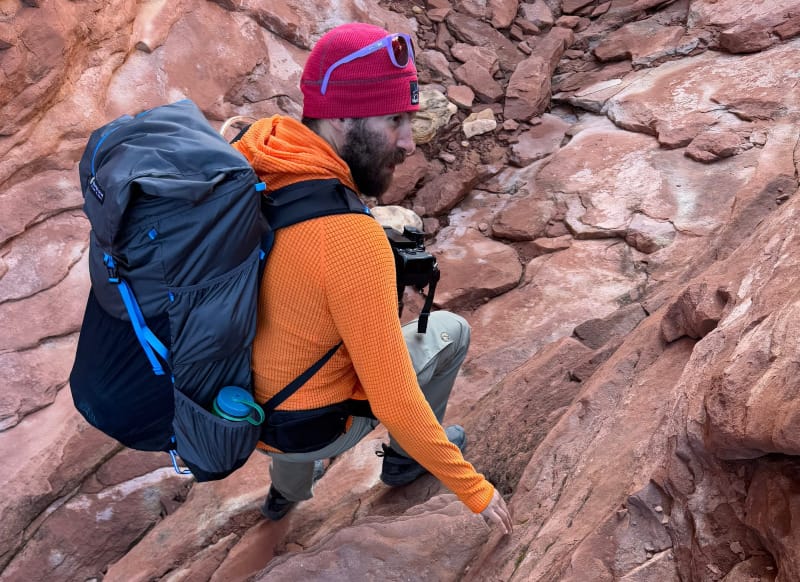
In my testing, the E10 Mini is "Small and Mighty." It’s rated at 10 Watts, and while you won't be charging a laptop with this, it generated a respectable 740 mAh per hour in direct sun. It’s the perfect companion for a minimalist who just needs to keep a headlamp and a Garmin InReach topped off. I clipped it to the top of my pack during a trek through the Enchantments, and its slim profile meant it didn't catch on low-hanging branches like the larger BigBlue.
Pros:
- Incredibly lightweight at 7.3 ounces.
- Folds into a tiny, pocketable footprint.
- Integrated carabiner loops for pack mounting.
Cons:
- Low output requires long exposure times.
- Only one USB output port.
Best for Basecamp & Power Stations: Goal Zero Nomad 50
When I’m setting up a stationary basecamp for a week of climbing, I’m usually carrying more than just a phone. I’ve got camera batteries, a tablet for topo maps, and maybe a small portable power station. For these scenarios, you need a heavy hitter. The Goal Zero Nomad 50 is that beast.
Generating 3,887 mAh in just two hours of field testing, the Nomad 50 is designed to chain. It features an 8mm connector specifically for charging larger power stations like the Goal Zero Yeti or Jackery Explorer series. It’s "Rugged but Heavy," weighing in at nearly 7 pounds. You aren't going to hike twenty miles with this strapped to your back, but for vehicle-supported wild camping, it’s the gold standard.
Pros:
- Massive 50W output for large devices.
- Built-in kickstands for perfect solar alignment.
- High-build quality with monocrystalline cells.
Cons:
- Expensive.
- Way too heavy for backpacking.
Best Budget Pick: Blavor 10W Solar Panel
You don’t always need to drop $100+ to stay powered. The Blavor 10W is a surprising contender that offers high functionality for under $50. Weighing in at 12.6 oz, it’s a bit heavier than the FlexSolar, but it feels significantly more "bombproof."
In our testing, it delivered 680 mAh/hr, which is surprisingly efficient for its 10W rating. It’s a no-frills, two-panel design. I recommend this for weekend warriors who want a reliable backup without making a massive investment. It’s the kind of gear you throw in the bottom of your pack and forget about until you actually need it.
Pros:
- Affordable entry point into solar.
- Solid, impact-resistant construction.
Cons:
- Slow charging for high-capacity batteries.
- USB-A only (no USB-C).
The Survivalist Choice: GOODaaa PN-W31 with Hand Crank
Sometimes, the sun doesn't cooperate. If you’re heading into a region known for "Type 2 Fun"—think constant drizzle and heavy canopy—you need redundancy. The GOODaaa PN-W31 isn't just a solar panel; it's one of the most versatile lightweight solar power banks I’ve tested.
It features a massive 45,800 mAh internal capacity and a series of fold-out panels. But the real kicker? An integrated hand-crank generator. If the sky is black and your phone is dead, you can literally grind out enough power for an emergency call. It’s the "Survivalist Choice" for a reason. While the solar charging is slower due to the smaller panel surface area, the internal storage means you can harvest energy whenever the sun decides to peek out.
Pros:
- Hand-crank for 100% emergency power.
- Massive internal storage (45,800 mAh).
- Built-in flashlight and compass.
Cons:
- Very slow to charge the internal bank via solar alone.
- Heavy (1.3 lbs).
Critical Buying Guide: How to Choose Off-Grid Solar Gear
Choosing a solar charger isn't just about picking the highest wattage. It’s about understanding the physics of the wild. Here is what you actually need to know before you swipe that card:
Monocrystalline vs. Polycrystalline
Don't let the jargon bore you—this matters. Monocrystalline panels (the dark, sleek ones) are the gold standard for wild camping because they achieve approximately 80% charging efficiency. Polycrystalline panels (the blueish, speckled ones) are cheaper but require a much larger surface area to produce the same power. For backpacking, always go Monocrystalline.
The Realistic Sunlight Window
For effective off-grid planning, you can expect 4 to 6 hours of peak sunlight per day. Even in mid-summer, the angle of the sun in the early morning and late evening is too shallow for high-speed charging. When calculating your power needs, base your math on a 5-hour window, not a 24-hour day.
The "Cloud Cover" Drop-off
Field testing shows a massive variance in charging efficiency depending on the sky. A high-quality panel like the BigBlue might hit 90% efficiency in the desert, but that can drop to 50% or lower under a light haze. If you’re camping in the UK or the Pacific Northwest, always size up your panel wattage to compensate for the "grey tax."
Pro Tip: Heat is the enemy of charging. A solar panel needs to be hot, but your phone or power bank should stay cool. Always use a long cable to keep your device tucked in the shade of your pack or under the panel itself. A lithium battery that gets too hot will actually stop accepting a charge to protect itself.
Pro Tips for Maximizing Solar Harvest
- The Two-Hour Adjustment: The sun moves, and your panel should too. If you’re at a stationary camp, reposition your panels every 2 hours to keep them perpendicular to the sun. This simple move can increase your daily yield by 30%.
- The Buffer Battery Rule: Never charge your phone directly from a solar panel if the sky is patchy. The constant "start-stop" of power can actually drain your phone’s battery as the screen wakes up repeatedly. Instead, charge a "buffer" power bank, then use that bank to charge your phone at night.
- Clean the Cells: Dust, salt spray, and finger oils reflect light away from the cells. Give your panels a quick wipe with a damp cloth every morning.
FAQ
Q: Can I charge my phone while it's raining? A: Most panels are water-resistant, but the USB ports are not. If it starts to drizzle, tuck the ports into a dry bag. Also, solar panels produce almost zero power in heavy rain, so you're better off packing it away to keep the electronics safe.
Q: Is a solar power bank better than a folding panel? A: It depends. A power bank with a single solar cell on top is great for emergency "top-offs," but it can take 50+ hours of sun to fully charge. For wild camping, a folding panel with at least 10W-20W of surface area is far more practical for daily use.
Q: How do I mount a panel to my backpack? A: Most panels come with carabiner loops. Secure the top two corners to your pack's lid and the bottom two to the sides. Ensure the panel is flat and not "taco-ing," as creases in the panel significantly reduce output.
Ready to Power Your Next Expedition?
Staying powered in the wild isn't about bringing a piece of the city with you—it’s about having the tools to stay safe and capture the moments that matter. For most of us, the BigBlue SolarPowa 28 is the clear winner, offering that perfect balance of weight and the 2,177 mAh/hr output needed for modern devices.
Grab your gear, check the weather, and get out there. The sun is waiting.